
The teams that outperform aren’t the most talented. They’re the most aligned.
TEAM EFFECTIVENESS
Most team problems are rooted in unclear objectives, undefined decision authority, and mismatched expectations about how work gets done. INDx works with leadership teams and cross-functional groups to diagnose what’s actually driving underperformance and build the operating foundation that lets capable people execute at their best.

WHO IT’S FOR
If any of these sound familiar, this work is for you.

INDx’s Team Effectiveness engagements are for leadership teams where structural or behavioral dysfunction is limiting what the organization can execute.


The team has recurring friction that no one can quite name or resolve
The same tensions surface in different meetings and different projects. Something feels “off,” and resolution is unclear.
A new leader, even an effective one, changes the operating dynamic. Implicit norms, decision patterns, and working relationships that develop over time no longer apply. Without deliberate work to re-establish them, teams lose months of momentum.
A leadership change has disrupted how the team operates
New reporting lines, merged functions, or expanded scope create ambiguity about who decides what, how resources are allocated, and what the team is actually accountable for. Org charts don’t answer those questions; deliberate team-level work does.
A reorganization has left teams without a clear operating model
Capable people aren’t producing the results the organization needs
The talent is there. The results aren’t. Missed handoffs, slow decisions, and unclear accountability rarely trace back to individual performance; they usually highlight unclear objectives, misaligned incentives, or undefined decision authority.
— WHY IT MATTERS
Team dysfunction is an organizational performance problem. It rarely resolves without deliberate engagement.
Most organizations recognize when a team isn’t working. Few have a structured process for diagnosing what’s driving it and addressing it with the same rigor they’d apply to any other performance problem. The cost of leaving it unaddressed compounds quickly.
80%
Of executives say team dysfunction has directly derailed a key business initiative, yet most organizations have no structured process for addressing it.
2x
Teams with high psychological safety, the kind that enables direct challenge and honest disagreement, are twice as likely to drive innovation and catch problems early.
“Teams that operate with clarity, trust, and defined accountability don’t just feel better, they outperform. The financial gap between a high-functioning team and a dysfunctional one continues to compound over time.”
INDx Team Effectiveness work is more intensive than most options on the market. It starts with a comprehensive behavioral analysis that maps individual profiles to team dynamics, surfaces where friction originates, and identifies the behavioral gaps. A Team Effectiveness Survey captures structural gaps. The facilitated work that follows focuses on objectives, operating norms, decision-making authority, and the trust conditions that enable a team to challenge one another productively. What organizations get at the end isn’t a better team culture; it’s a team that knows what it’s accountable for and has the structure to deliver it.


HOW IT WORKS
Team effectiveness and alignment are grounded in data and focused on performance.
FULL PROCESS & DELIVERABLES
Team Effectiveness One-Page Overview
Every phase, every deliverable, and what your organization gets at the end, in a single shareable document designed for the leaders making the decision to engage.
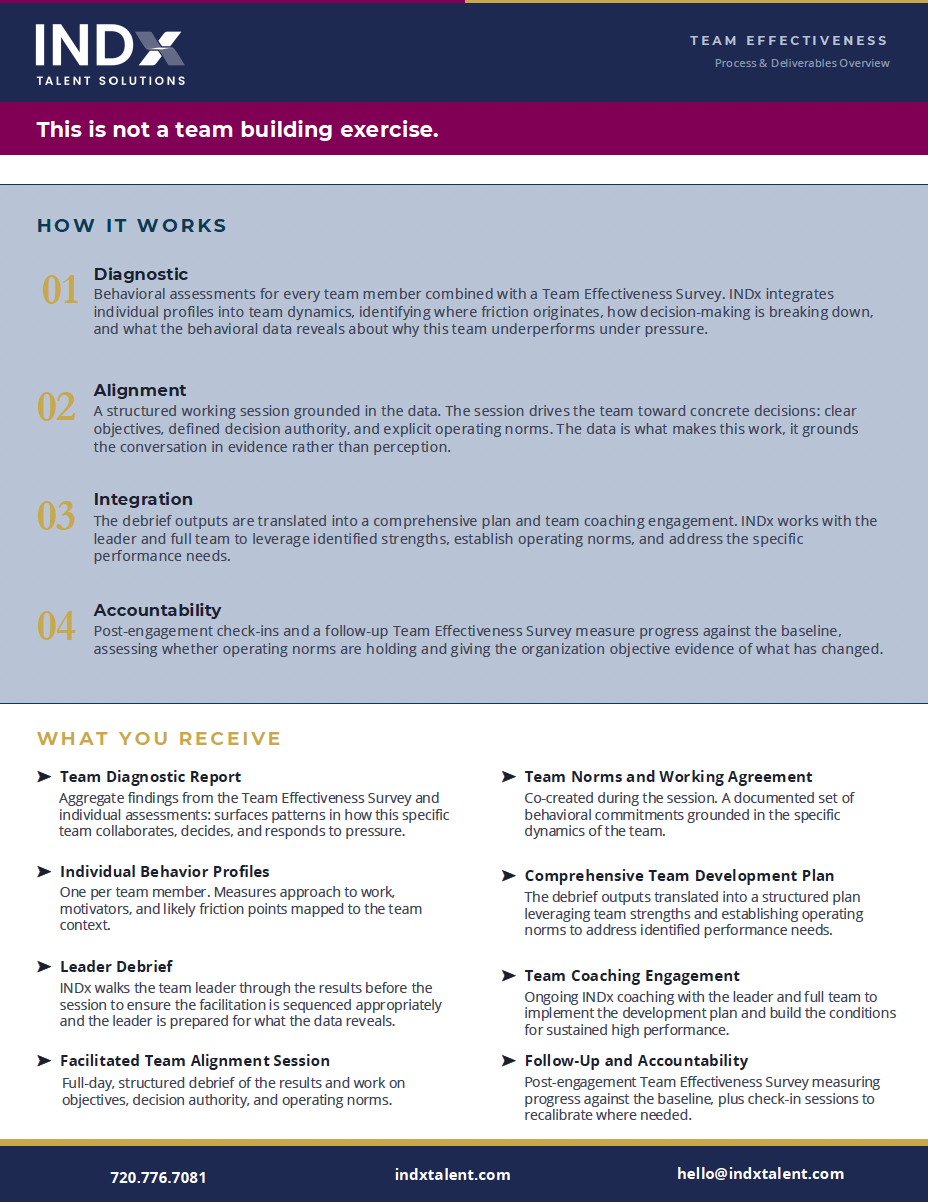
Behavioral assessments for each team member, combined with a Team Effectiveness Survey. INDx integrates individual results with the team’s current state to identify themes and gain insight into team potential, gaps, and alignment.
Diagnostic


Alignment
The debrief session outputs are translated into a comprehensive plan and team coaching engagement. INDx works with the leader and the full team to leverage identified strengths, establish operating norms, and address specific performance needs.
A structured session grounded in the data. The session drives the team toward concrete decisions: clear objectives, defined decision authority, explicit operating norms, and an honest account of what each person brings and needs from the team to perform.
Integration
Post-engagement check-ins and a follow-up Team Effectiveness Survey assess whether operating norms are holding and measure progress against the baseline.
Accountability
— FAQ
Questions we hear most often.
If you don't see your question here, bring it to the consultation. We are happy to talk through any aspect of the engagement before you get started.
-
A strategy session focuses on what the team is working on. INDx Team Effectiveness work focuses on how the team works, and is grounded in data, not facilitated conversation alone. The output isn’t a set of goals or priorities. It’s a set of structural decisions: what the team is accountable for, who decides what, what operating norms will govern how work gets done, and how each individual’s profile fits into the collective.
-
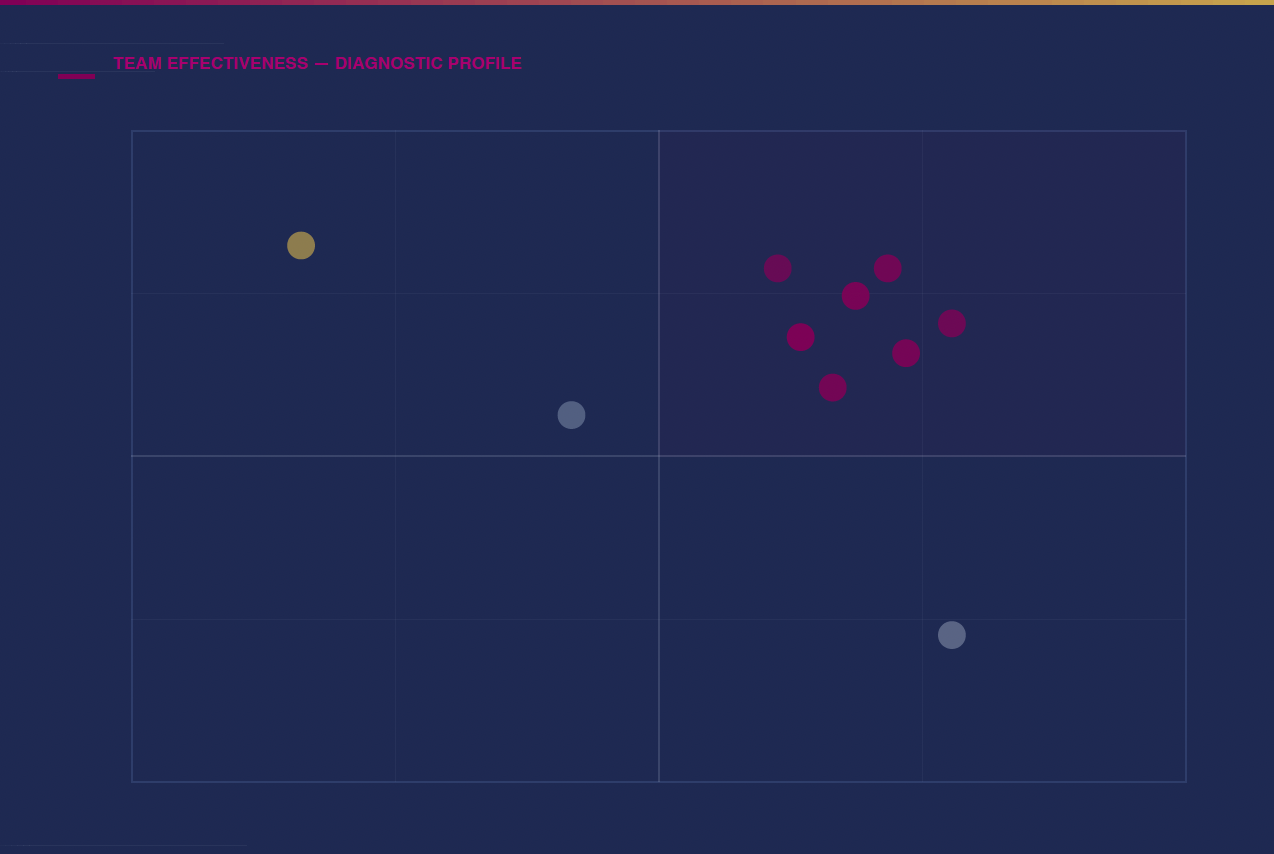
The integrated data combines validated behavioral assessments with a Team Effectiveness Survey. From the individual data, INDx builds a picture of how each team member is likely to operate, their approach to work and relationships, what motivates them, and where their patterns are likely to create friction within the team’s specific context. From the team survey, INDx surfaces patterns in how the team collaborates, makes decisions, and manages accountability. Taken together, the diagnostic gives the team leader a data-grounded picture of what’s driving performance or underperformance.
-
INDx always meets with the team leader before any team session to review the results and design the session. In cases where interpersonal tension is significant, INDx may recommend individual conversations before the team session. Not to soften the work, but to ensure the session can be productive rather than defensive. The goal is to create the conditions for honest, direct discussion.
-
Full participation produces the most accurate results and the most actionable session. If a key team member can’t participate, INDx will advise on whether to proceed, delay, or adjust the scope.
-
Yes, with some trade-offs. In-person sessions tend to produce faster, deeper progress, particularly when the work involves significant tension or the team hasn’t built sufficient trust to challenge each other directly.
Virtual sessions work well for teams with distributed geography where in-person isn’t feasible, or for follow-up checkpoint work after the initial in-person engagement. INDx will advise on format based on the needs of the team.
LET’S START A CONVERSATION
Ready to build the foundation your team needs to perform?
A 30-minute consultation with an INDx Talent senior practitioner. No pitch, no obligation. Just a focused conversation about what your team is dealing with and what a well-scoped engagement would look like.